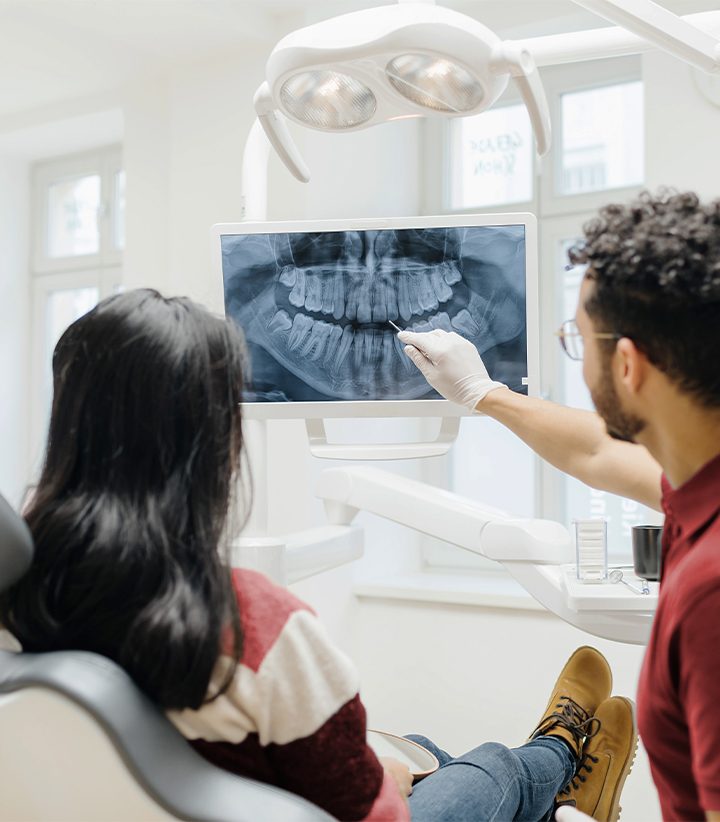
Did you know if you performed check-ups on ten adult patients per day for five days, your week would look like this:

  • 1.5 days of patients with untreated decay

  • 1 days of patients with severe periodontal disease 

  • 2.5 days of patients experiencing erosive tooth wear.[1-3]

The gold standard to reduce incidence of caries[4] and periodontal disease[5] is to brush twice a day with a standard Fluoride-containing toothpaste. However, non-carious tooth loss caused by erosion is challenging, and standard Fluoride-containing toothpastes mitigates erosion in a limited way compared with the research-backed use of polyvalent fluorides[6]. Given nearly half of your patient population are likely to experience erosive toothwear, the question then arises what toothpaste can you actively recommend to help your patients manage erosive non-carious tooth?

Experts note that variability in toothpaste formulations and consequent effectiveness suggest that "All fluorides are not equal"  when it comes to protection from erosion[3, 7, 8].

Not All Fluorides Are Created (or Behave) Equally When it Comes to Erosion

Most standard toothpastes contain monovalent fluorides like sodium fluoride or sodium monofluorophosphate. When applied to the tooth surface, monovalent pastes form calcium fluoride. However, polyvalent compositions, such as those containing stannous fluoride (SnF₂ ), form a SnF₂ layer on the tooth and this has a key advantage when it comes to protection against erosion, as it creates an acid resistant protective layer[6].

SnF₂  toothpastes are proven to; 

  1. Prevent erosive wear and remineralise tooth surfaces.

  2. Alter the bacterial profiles of plaque .

Stannous Fluoride Mitigates Tooth Surface Loss from Erosion

Two weeks of polyvalent SnF₂  toothpaste use remineralises tooth surfaces by enhancing bioavailable fluoride deposition on the tooth surface[9, 10]. Furthermore, monovalent calcium fluoride dissolves easily in an acid-challenged environment, while polyvalent SnF₂  resists and protects the hard tissue to prevent erosion by a[6, 9, 11].modifying the salivary pellicle to influence the attachment of oral bacteria[11, 12].

While the primary focus of this article is erosion,  SnF₂ toothpastes are effective antibacterial agents. Studies have reported that  two months of brushing with a SnF₂toothpaste significantly reduces bacterial plaque growth and composition compared to monovalent pastes[9]; plaque compositions change to increase  protective S. salivarius and reduce S. mutans and P. gingivalis populations.[8, 12, 13]

The effectiveness of SnF₂ toothpastes to address erosion and other oral care concerns have been known for over fifty years[10]. Yet  SnF₂ toothpaste stability and consequent bioavailability[14] has historically challenged the large-scale manufacture and distribution of stable SnF₂  toothpastes[15].

The Challenge: Bioavailability

Environmental oxygen exposure to pastes, both during packing and storage increases exponentially each time the tube lid is opened to break down SnF₂[15-17]. Unlike monovalent toothpastes, SnF₂ formulations exposed to environmental oxygen or heat, high water-containing formulations break down into biologically ineffective stannous species[15, 18]. The retention of stannous ions is essential to improve bioavailability[19]. How can we stabilise stannous ions in toothpaste?

A Winning Formula – Colgate Total Active Prevention

To maintain water solubility, stability and bioavailability, Colgate has developed a novel SnF₂  toothpaste.  The new SnF₂ formulation is stabilised with nitrates to block stannous conversion in variable environmental conditions, and phosphates to maintain water solubility[14, 19]. The Colgate Total Active Prevention stabilised with nitrate and phosphate (SNaP) maintains high bioavailability of stannous species over time[19].

The key takeaway? Colgate Total Active Prevention offers multifaceted benefits.  The improved bioavailability of stannous ions significantly benefits patients who need erosion protection. Consequently, Colgate Total Active Prevention should be a high priority as part of your erosion management plan for your patients.

References
  1. Bernabe, E., et al., Trends in the global, regional, and national burden of oral conditions from 1990 to 2021: a systematic analysis for the Global Burden of Disease Study 2021. The Lancet, 2025. 405(10482): p. 897-910.
  2. Affairs., D.o.E.a.S. Worldometer. [Webpage ] 2025  [cited 2025 August 9]; Available from: https://www.worldometers.info/world-population/world-population-by-year/.
  3. Schlueter, N. and B. Luka, Erosive tooth wear – a review on global prevalence and on its prevalence in risk groups. British Dental Journal, 2018. 224(5): p. 364-370.
  4. Walsh, T., et al., Fluoride toothpastes of different concentrations for preventing dental caries. Cochrane Database of Systematic Reviews, 2019(3).
  5. Joshi, S., et al., Toothbrushing behaviour and periodontal pocketing: An 11-year longitudinal study. Journal of Clinical Periodontology, 2018. 45(2): p. 196-203.
  6. da Silva, B.M., et al., Effect of fluoride group on dental erosion associated or not with abrasion in human enamel: A systematic review with network metanalysis. Archives of Oral Biology, 2022. 144: p. 105568.
  7. Faller, R.V. and W.H. Noble, Protection From Dental Erosion: All Fluorides are Not Equal. Compend Contin Educ Dent, 2018. 39(3): p. e13-e17.
  8. Samaranayake, L., et al., Facts and Fallacies of the Fluoride Controversy: A Contemporary Perspective. International Dental Journal, 2025. 75(4): p. 100833.
  9. Nicholson, J.W., Stannous Fluoride in Toothpastes: A Review of Its Clinical Effects and Likely Mechanisms of Action. Journal of Functional Biomaterials, 2025. 16(3): p. 73.
  10. Radike, A.W., et al., Clinical evaluation of stannous fluoride as an anticaries mouthrinse. The Journal of the American Dental Association, 1973. 86(2): p. 404-408.
  11. Algarni, A., et al., The impact of stannous, fluoride ions and its combination on enamel pellicle proteome and dental erosion prevention. PloS one, 2015. 10(6): p. e0128196.
  12. Baty, J.J., S.N. Stoner, and J.A. Scoffield, Oral commensal streptococci: gatekeepers of the oral cavity. Journal of Bacteriology, 2022. 204(11): p. e00257-22.
  13. Cheng, X., et al., Comparative effect of a stannous fluoride toothpaste and a sodium fluoride toothpaste on a multispecies biofilm. Archives of Oral Biology, 2017. 74: p. 5-11.
  14. Zhang, S., et al., Oxidative stability of chelated Sn (II)(aq) at neutral pH: the critical role of NO3− ions. Science Advances, 2024. 10(40): p. eadq0839.
  15. Myers, C.P., et al., Solving the problem with stannous fluoride: Formulation, stabilization, and antimicrobial action. The Journal of the American Dental Association, 2019. 150(4, Supplement): p. S5-S13.
  16. West, N.X., et al., A randomised crossover trial to compare the potential of stannous fluoride and essential oil mouth rinses to induce tooth and tongue staining. Clinical Oral Investigations, 2012. 16(3): p. 821-826.
  17. Manus, L.M., et al., The Evolution of Colgate Total®: A New Era Stabilized by Nitrate and Phosphates. Compend Contin Educ Dent, 2024. 45(Suppl 3): p. 6-10.
  18. Vinant, M., et al., Oral contact stomatitis related to toothpaste use: A report of 15 cases. JEADV Clinical Practice, 2024. 3(2): p. 672-675.
  19. Chakraborty, B., et al., Antibacterial effects of a novel stannous fluoride toothpaste stabilized with nitrate and phosphates (SNaP): in vitro study and randomized controlled trial. Compend Contin Educ Dent, 2024. 45: p. 12-20.